


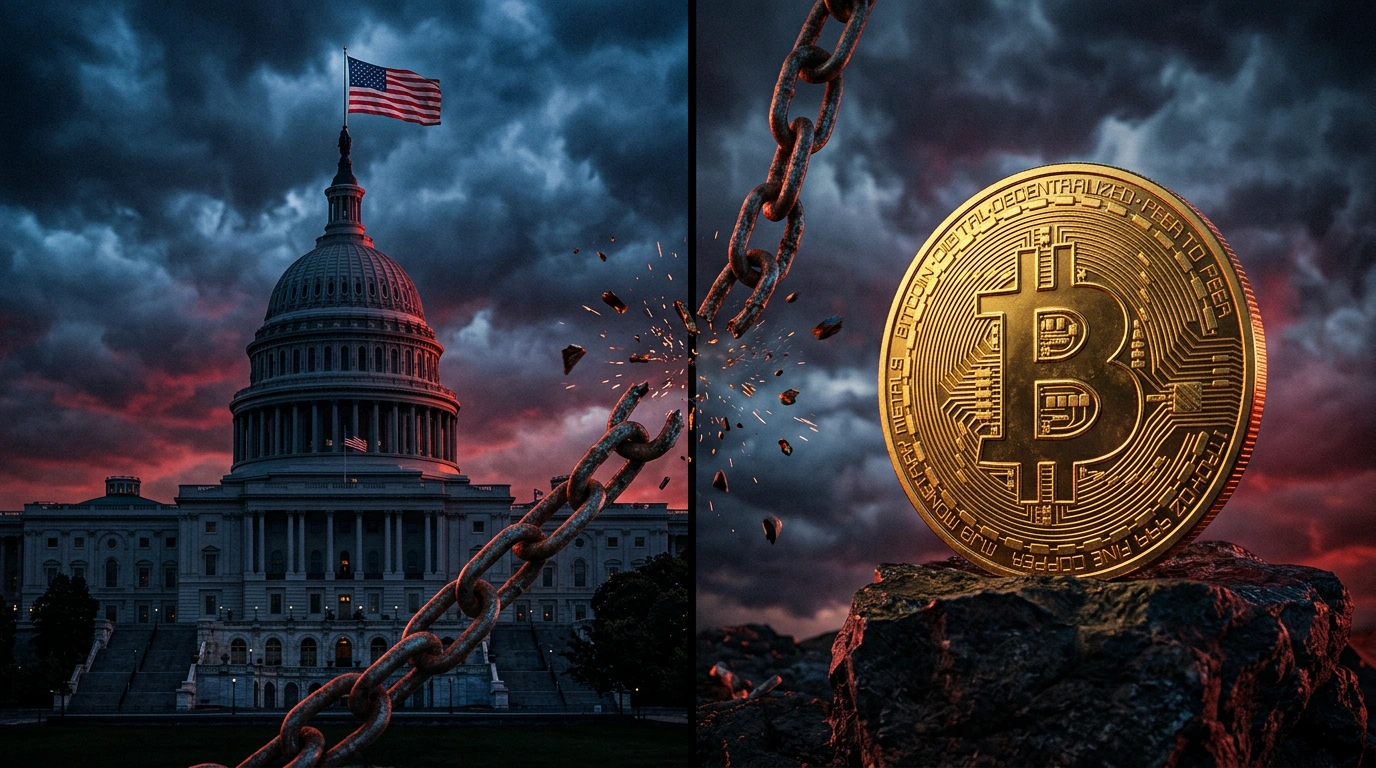
April 2, 2026 marks exactly one year since President Donald Trump declared Liberation Day - the most sweeping tariff reform in US history. Over the past year, the Supreme Court ruled the key tariffs illegal, the government became liable for over $160 billion in refunds, and Bitcoin suffered its worst quarter since 2018. Yet on the anniversary, Trump signed new duties on metals and pharmaceuticals.
What Was Liberation Day
On April 2, 2025, Trump declared a trade emergency and imposed "reciprocal tariffs" on imports from 57 countries. The baseline rate was 10%, with rates up to 50% for specific countries. The EU faced a 20% tariff, China temporarily up to 145%. It was the most sweeping US tariff action in nearly a century.
The legal basis was the International Emergency Economic Powers Act (IEEPA) - a law allowing the president to regulate trade during a national emergency. IEEPA had never before been used for mass tariffs, which became the basis for legal challenges.
Supreme Court: Tariffs Are Illegal
On February 20, 2026, the Supreme Court ruled 6-3 against the administration in Learning Resources, Inc. v. Trump. The Court held that while IEEPA permits the president to "regulate" imports during a national emergency, this language does not authorize the imposition of tariffs without explicit congressional approval.
Following the ruling, the average effective US tariff rate on imports dropped from approximately 14% to 11%. However, the $160 billion refund process remains complex - the Supreme Court referred the refund question to the US International Trade Court, with no clear timeline.
New Tariffs on the Anniversary
On Liberation Day's anniversary, Trump signed new trade actions, bypassing the Supreme Court ruling by using Section 232 (national security):
- Metals: flat 50% rate on steel, aluminum, and copper products. Derivative articles at 25%. Goods with metal content below 15% are exempt
- Pharmaceuticals: 100% duty on imported patented drugs. Companies committing to US manufacturing pay 20%
- Market price valuation: duties are now based on the US spot price rather than the importer's declared value, closing a price deflation loophole
The administration also announced that 13 pharmaceutical companies have committed $400 billion in US manufacturing investments over the past year.
How the Trade War Impacted Bitcoin
Tariff uncertainty was a key pressure factor on the crypto market in Q1 2026. Bitcoin lost 23% in Q1, its worst result since 2018, closing the quarter at $67,800.
Ethereum fell even harder, down 33% for the quarter to $2,070. The Fear & Greed Index has been at 8 out of 100 for 46 consecutive days - the longest extreme fear streak since the FTX collapse.
Following tariff volatility, traders increasingly conducted Bitcoin-to-dollar exchanges, seeking to lock in positions ahead of the White House's next trade decisions.
Bitcoin as a Risk Asset in the Trade War
Analysts at 21Shares note that Bitcoin's reaction to Liberation Day tariff shocks confirmed that BTC still trades as a risk asset rather than "digital gold." Every escalation of the trade war was accompanied by crypto selloffs alongside equities.
At the same time, the long-term narrative is shifting. Following the Supreme Court ruling, trade policy uncertainty has somewhat decreased, potentially reducing pressure on risk assets. If the Fed decides to cut rates following a weak labor market, this could catalyze a recovery.
What Comes Next
Despite the Supreme Court ruling, the trade war hasn't ended, it has merely changed form. Trump has shifted from IEEPA to Section 232 and targeted sectoral duties. In April, the market also anticipates the CLARITY Act markup in the Senate, which could establish clear rules for the crypto market.
For Bitcoin and crypto, the central question remains unchanged: whether the market can transition from a risk asset to a genuine hedge against macroeconomic instability. The coming months will show whether the Supreme Court ruling becomes a turning point for recovery.


Comments
Your email address will not be published. Required fields are marked *