


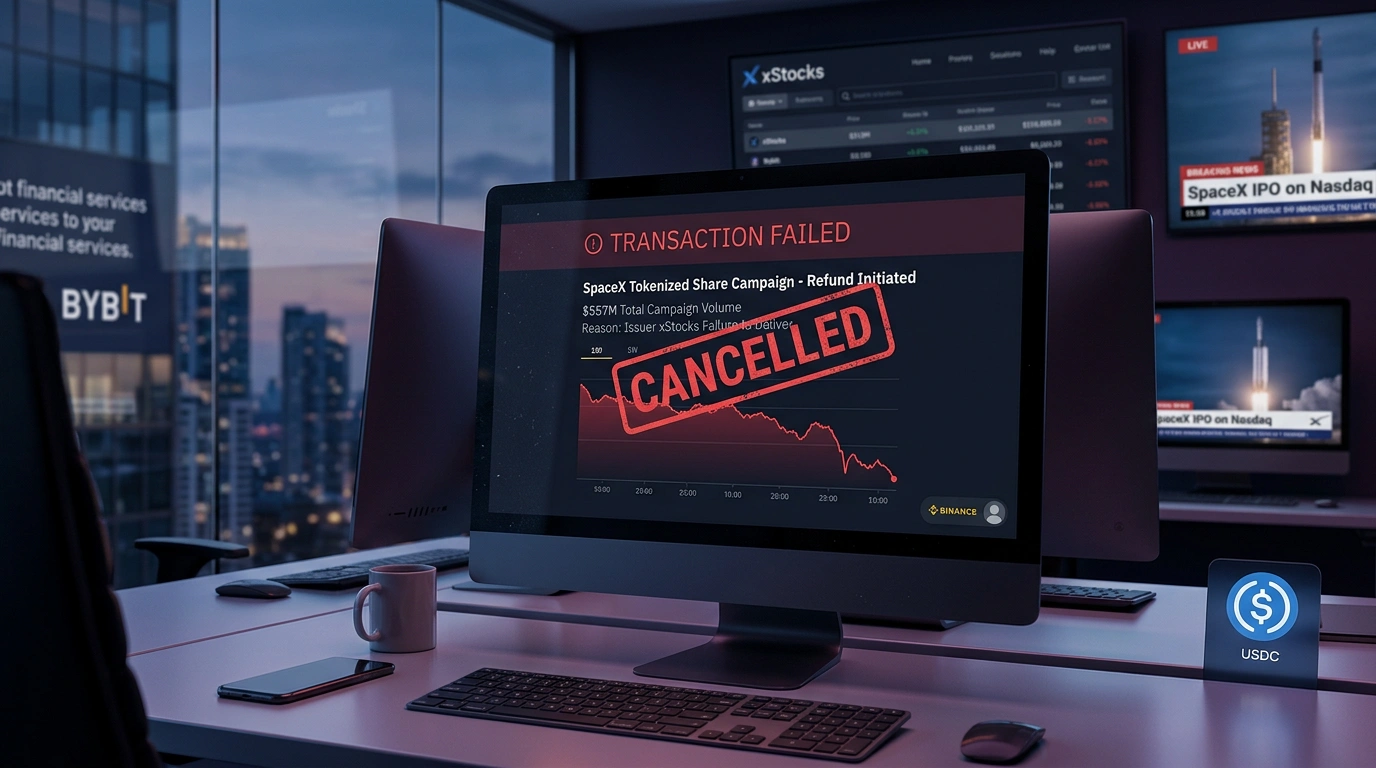
SpaceX went public on the Nasdaq on June 12, 2026, setting a record: the $75 billion IPO became the largest in US market history. Shares opened at $150, above the $135 IPO price, and closed at $161.11, pushing the company's market cap past $2 trillion. Thousands of crypto users who signed up for tokenized SpaceX access through Binance, Bybit, Bitget Wallet, and MEXC instead received cancellation notices and refund promises.
Record IPO: $75 Billion Raised and a $2 Trillion Valuation
SpaceX priced its shares at $135. The IPO was more than four times oversubscribed, with demand far exceeding supply. Shares opened at $150 and finished the day at $161.11. Elon Musk's company crossed the $2 trillion market cap threshold and joined the ranks of the most valuable public companies on the planet.
The $75 billion raised surpasses every prior US IPO record. No public listing in America had ever pulled in that much capital. Large institutional funds and retail investors showed up at the same time, driving the order book past any reasonable projection. The crypto sector tried to tap into this demand through tokenized campaigns and promised its users a seat at a listing that would otherwise have been out of reach.
How Four Platforms Raised $557 Million and Delivered Nothing
Before trading began, four major crypto platforms launched tokenized access campaigns for the SpaceX IPO. Binance collected more than $557 million in USDC from participants. By total volume, one of the largest tokenized campaigns the platform had ever run. Bybit launched a program called "Bybit IPO Express." Bitget Wallet and MEXC also opened subscriptions. All four relied on xStocks (a platform controlled by Kraken) as the supplier of underlying assets.
When Nasdaq trading started and SpaceX shares moved higher, xStocks was unable to deliver tokenized positions to any of the platforms. Binance was first to announce the cancellation. Bybit, Bitget Wallet, and MEXC followed. All four began refunding participants and sent out official notifications.
xStocks: One Supplier Took Down Every Campaign
xStocks, controlled by Kraken, served as the shared supplier of underlying assets for all four platforms. That single dependency became the failure point. Binance attributed the collapse to "circumstances outside our control." Bybit cited xStocks' "inability to deliver the underlying assets." Bitget Wallet COO Alvin Kan posted on X: "We are in the process of sending out the refunds. Yes, we have hit a setback, and trust in the industry has taken a blow, but we'll come out of this stronger."
The exact cause remains undisclosed. Several explanations are possible: regulatory restrictions on acquiring shares from underwriters, a technical failure in custodial chains, or an underestimation of demand. CZ (Changpeng Zhao) posted on X confirming the cancellation from Binance Wallet's side. No technical details were provided.
All four platforms directed responsibility toward xStocks in identical terms. That framing softened the reputational damage to the platforms themselves, but it exposed a structural problem: for a campaign with $500+ million and four major participants, the entire setup rested on a single supplier with no backup plan.
SPCX Climbed, BTC Held Steady
While the tokenized campaigns ended without asset delivery, the synthetic SPCX token market reacted positively. SpaceX shares opening at $150 gave a clear reference point for repricing crypto analogs. SPCX, a derivative tracking SpaceX, rose in line with the underlying stock and rewarded those who held it going into IPO day.
Bitcoin traded around $64,000 on IPO day. The tokenization campaign failures had no meaningful impact on BTC price. Analysts noted that returning $557 million in USDC to Binance participants could briefly affect stablecoin supply flows, but no significant market moves materialized.
SPCX holders came out ahead of campaign participants. The synthetic token tracked the actual stock gains. Campaign participants, by contrast, got their USDC deposits back with zero return and, more painfully, missed the chance to enter at the $135 IPO price.
RWA's First Real Stress Test: What the Sector Learned
Real-world asset tokenization has been one of crypto's loudest narratives for the past two years. Platforms set firm expectations for their users: you will get access to IPOs that retail investors cannot reach through traditional markets. SpaceX was the first real test of those promises at a scale measured in hundreds of millions of dollars.
The test failed. Two structural weaknesses appeared at once: supply concentrated through a single intermediary and no fallback mechanisms in place. When xStocks could not deliver, none of the four platforms had a ready backup plan. Users found out after the IPO had already closed and the $135 entry window was gone.
The RWA market is growing, but the operational infrastructure under it is not keeping pace. The next major public listing will show whether platforms and providers actually took lessons from this episode.

Comments
Your email address will not be published. Required fields are marked *