


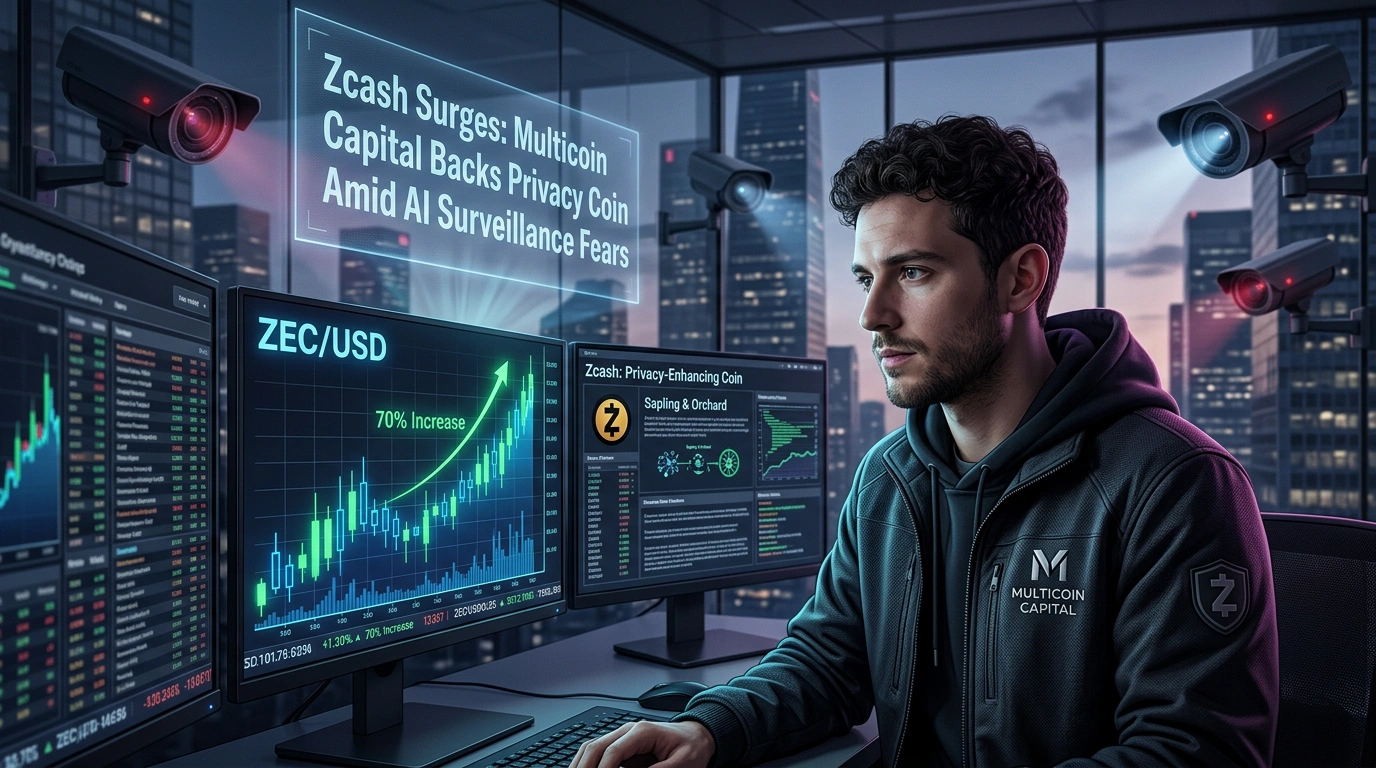
Zcash gained over 70% in seven days. The price climbed from $346 in early May to a weekly high of $593.86 on Wednesday, and is now trading around $570. Two factors drove the move: a public disclosure by Multicoin Capital of a significant position in ZEC, and growing anxiety among traders about AI-powered financial surveillance. For the broader market, this is the clearest sign yet that the privacy coin narrative is gathering capital again after a quiet first quarter.
How ZEC climbed from $346 to $593 in one week
The move fits the narrative trade playbook. Slow accumulation first, then a sharp spike when a credible name steps forward. That name was Multicoin Capital. Co-founder Tushar Jain announced on Wednesday that the fund had been building its ZEC stake since February. Volume spiked immediately, and the token hit its weekly high of $593.86 the same day.
Analytics platform Santiment tracked a simultaneous jump in price and social mentions for Zcash, with its FOMO indicator surging. "The crowd is increasingly viewing privacy-focused assets as a hedge against growing surveillance concerns, tighter exchange regulations and expanding AI-driven data tracking," Santiment noted. Monero (XMR) moved alongside ZEC, trading around $388 on Friday. Multiple privacy coins moving together signals a category rotation, not just a single-coin anomaly.
Multicoin Capital and the trade against asset seizure
Jain framed the position as ideological rather than speculative. He argued that institutions are increasingly seeking private assets to shield themselves from what he called a "political trend to seize private wealth." He described the move as a "return to the cypherpunk ideals crypto was founded on." An attempt to recast ZEC from a niche protocol into an institutional protection tool.
The Multicoin signal carries weight because of the firm's reputation. They built the position from February, well before the public announcement. That sequencing points to conviction, not reaction. Swyftx lead market analyst Pav Hundal told Cointelegraph that traders are genuinely paying closer attention to privacy projects due to concerns about AI, quantum computing and financial surveillance of crypto transactions. The fact that a firm of Multicoin's standing stepped out publicly changes the trading dynamic for ZEC.
AI surveillance and Q-Day: when threats get closer to real
Fear of quantum computing shifted from theoretical to closer to practical this week. Project Eleven's report warned that Q-Day may arrive as early as 2030. That is the point when quantum machines could break the cryptography protecting most blockchains. A researcher already cracked a 15-bit ECC key on public quantum hardware earlier this month. This is no longer a drill.
Coinbase previously flagged Ethereum and Solana as facing elevated quantum risk due to their proof-of-stake architecture. Polygon launched private stablecoin payments last Sunday, and Aptos activated Confidential APT in April. Zcash enters this moment as the project that was building for privacy before the rest of the market made it a theme. That history supports the narrative driving its price.
What sits behind the price: the network's technical state
Zcash Open Development Lab founder and CEO Josh Swihart spoke at Consensus Miami this week and outlined concrete targets. Quantum-recoverable wallets are set to roll out within a month. Full post-quantum status is planned in 12 to 18 months. In the same window, the network aims to reach Mastercard and Visa-level throughput. For context: Swihart also called Bitcoin "at its core broken" as a private peer-to-peer payment system.
On-chain data backs more than just the price. Zcash's shielded pool now holds 30% of all circulating supply. An all-time high for the network. The cross-chain route via Near Intents and the Electric Coin Company mobile wallet has processed $600 to $700 million since launch, mostly in USD and USDC pairs. Real usage is growing, not just the ticker.
The rally could end as fast as it began
Hundal is not calling this a clean break. He said the move has the hallmarks of "narrative rotation into privacy coins" and warned against reading it as a deep repricing just yet. The market has been here before: Zcash nearly hit $700 in November 2025 and Monero set an all-time high of $797 in January. Neither held.
Three things to watch:
- Volume persistence: if trading activity drops sharply after the peak, the move reverses fast
- Institutional follow-through: Multicoin opened the position, but whether other major funds join in is still open
- Regulatory pressure: FATF and a number of exchanges continue to push back on privacy coins. Several platforms have already delisted ZEC and XMR
The technical work inside Zcash is genuine. But the market is still pricing the narrative, not the shielded pool. If regulatory pressure increases or institutional capital does not follow Multicoin, ZEC will give back the gains just as quickly as it captured them.


Comments
Your email address will not be published. Required fields are marked *