


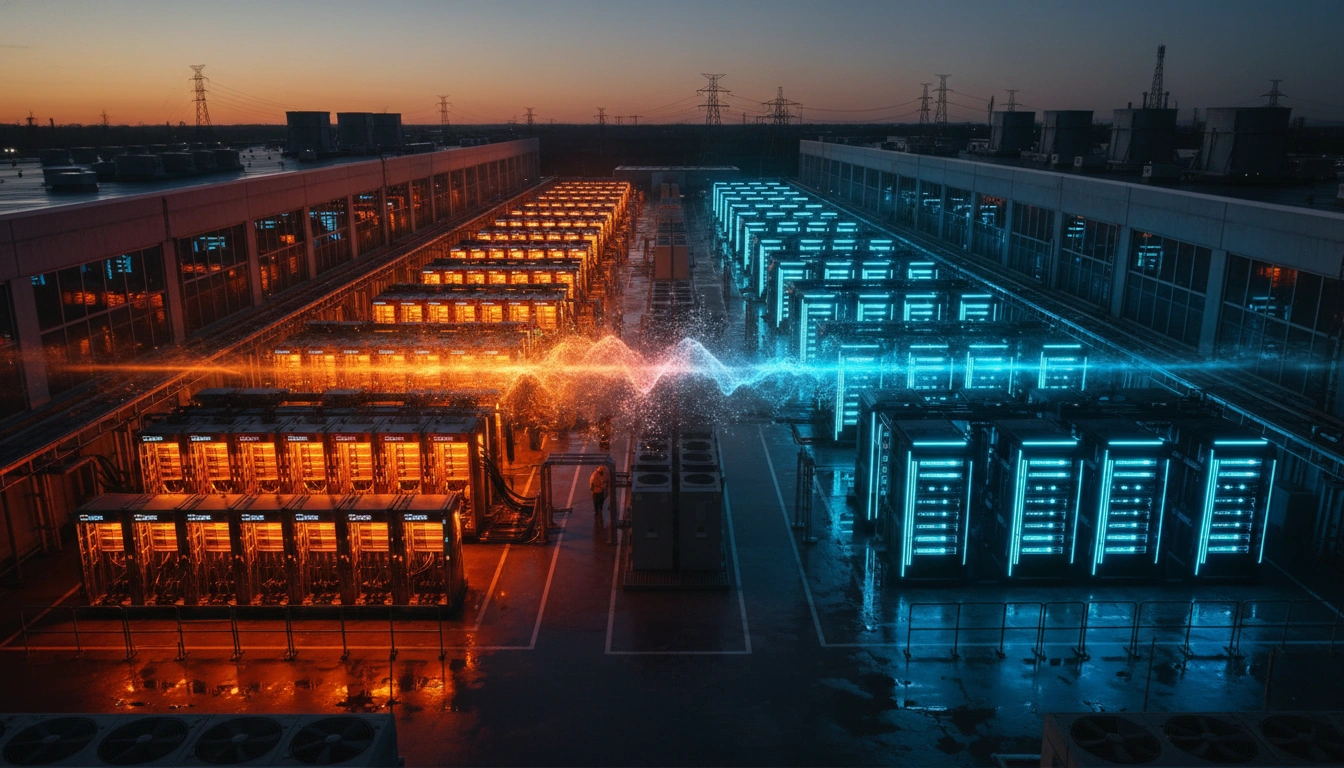
The Bitcoin mining industry is undergoing its most dramatic transition ever. According to CoinShares' quarterly report published on March 26, the average cash cost to produce one BTC among publicly listed miners rose to approximately $80,000 in Q4 2025. With the current market price hovering around $66,500, every mined coin generates a loss, pushing the industry's biggest players toward a radically different path, artificial intelligence.
The toughest quarter since the halving
Q4 2025 proved to be the most challenging period for the mining industry since the April 2024 halving, when block rewards were cut in half. Bitcoin's price declined from roughly $124,500 in October to about $86,000 by late December, sharply compressing margins.
Hashprice - the key metric measuring revenue per unit of computing power, dropped to $36-38 per petahash per second per day during Q4. By early 2026, it had plunged further to approximately $29, one of the lowest readings in the industry's history.
Why artificial intelligence
Mining companies hold a critical competitive advantage for the AI transition: they already operate large data centers with robust power supply, cooling systems, and grid connectivity. These resources are the scarcest elements for deploying AI infrastructure, and building them from scratch can take years.
While AI equipment costs are significantly higher. $8 to $15 million per megawatt versus $700,000 to $1 million for mining - the returns are also substantially greater. Long-term contracts with technology corporations provide stable and predictable cash flow, in stark contrast to the volatility of cryptocurrency markets.
Contracts worth tens of billions
The scale of the evolution is staggering. The five largest deals in the sector:
- TeraWulf - cumulative HPC contracts totaling $12.8 billion; the company increased its total debt to $5.7 billion to finance the transition
- Core Scientific + CoreWeave - a $10.2 billion deal spanning 12 years, the largest individual contract in the industry
- Hut 8 - a 15-year, $7 billion agreement for AI infrastructure at its River Bend campus
- IREN - raised $3.7 billion through convertible notes to fund its HPC transition
- Cipher Mining - secured $1.7 billion in financing to develop AI capacity
In total, public miners have announced over $70 billion in cumulative AI and high-performance computing contracts. Key clients include cloud providers and technology companies that urgently need capacity for training large language models and other AI workloads.
Massive sell-off of Bitcoin reserves
To fund the transition, miners are actively selling their Bitcoin holdings. Public companies have collectively reduced BTC reserves by over 15,000 coins from peak levels. Core Scientific plans to sell its Bitcoin for dollars almost entirely during 2026, while MARA Holdings - the largest public holder with 53,822 BTC, has expanded its sales policy to allow liquidation of balance sheet coins.
MARA's case is particularly telling: the company, which until recently maintained an accumulation strategy, was forced to change course after the loan-to-value ratio on its $350 million credit facility reached 87% due to Bitcoin's price decline.
Implications for the network and market
The mass exodus of computing power from mining to AI is already affecting the Bitcoin network. Declining hashrate reduces mining difficulty, improving economics for operators who remain committed to mining. At the same time, selling thousands of coins creates additional price pressure that the market must absorb.
For investors, the change signals a deep revaluation of mining stocks. Companies that just two years ago defined themselves exclusively as cryptocurrency miners now compete for contracts with Meta, Microsoft, and other tech giants. Their valuation will increasingly depend on demand for AI computing rather than Bitcoin's price, and this may be the biggest paradigm shift in the industry's history.

Comments
Your email address will not be published. Required fields are marked *