


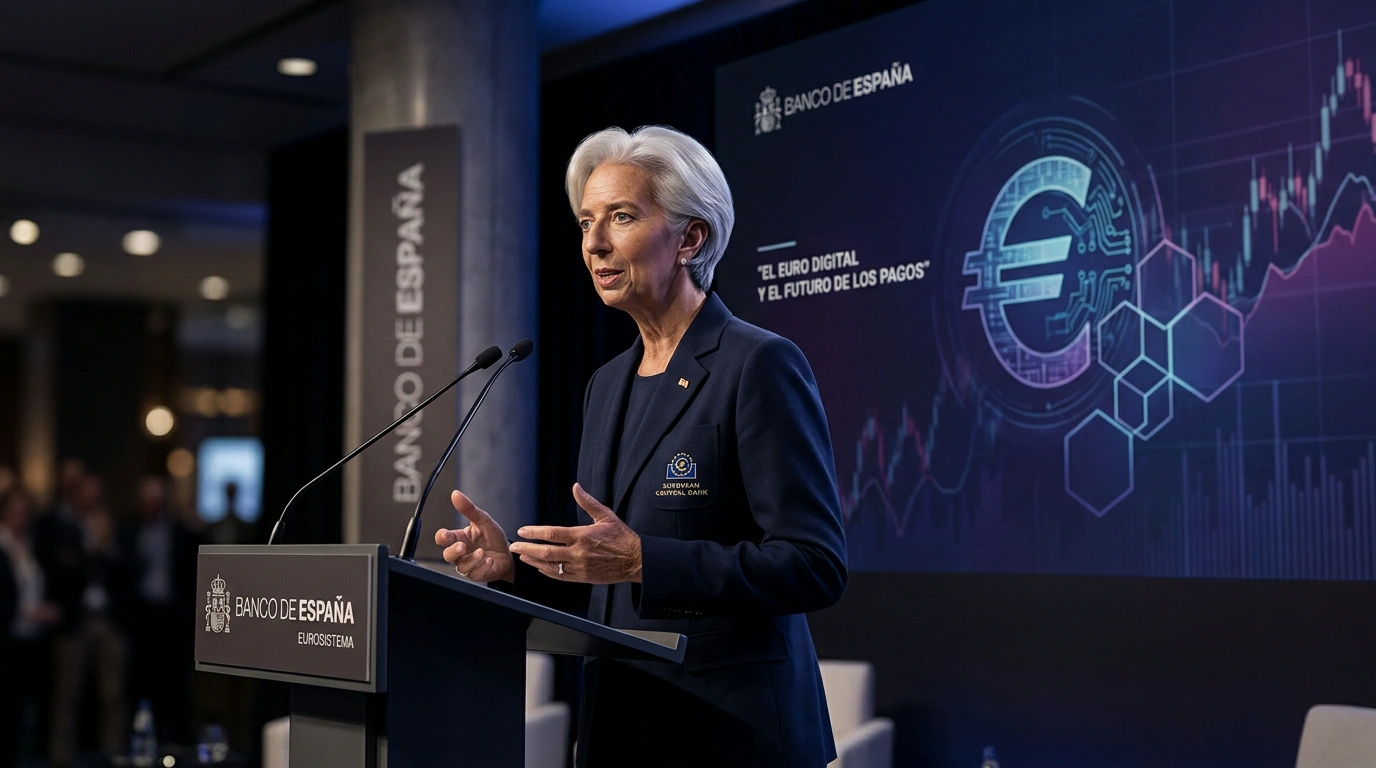
European Central Bank President Christine Lagarde rejected the idea that euro stablecoins could strengthen the euro's international role. Speaking on May 8 at the Latam Economic Forum Banco de Espana in Spain, she said Europe "knows which port it is sailing to", and that destination is not towards private stablecoins. The ECB's position runs counter to the US approach, where dollar-backed stablecoins are actively promoted as a tool for preserving the dollar's global reserve status.
What did Lagarde say at the forum?
Lagarde delivered one of the ECB's clearest public statements yet on euro stablecoins. She argued that stablecoins are not an efficient path to boosting the euro's international standing. The question is no longer whether such tokens should exist at all, but whether jurisdictions can afford to ignore them.
"It is no longer about whether stablecoins should exist, but whether jurisdictions can afford to be without them."
Christine Lagarde, ECB President, speech at Latam Economic Forum Banco de Espana, May 8, 2026
The stakes in this debate are real. US companies from Tether to Circle and PayPal are pushing dollar stablecoins hard, with the new US administration officially backing that direction. If Europe does not respond with a competitive product, the euro risks losing further ground to the dollar in digital payments. Dollar-backed stablecoins already control around 98% of the global stablecoin market.
Where does the ECB see the risks?
Lagarde proposed separating stablecoins into two distinct functions, namely monetary and technological. The ECB's view is that these two functions are constantly conflated in public debate, which leads to flawed conclusions.
On the monetary side, the ECB acknowledges that euro stablecoins under MiCA regulation could theoretically generate additional demand for euro-area safe assets. But the trade-offs are significant. Risks include potential fund runs, reserve fragility and weaker monetary policy transmission if deposits shift from banks to stablecoin issuers at scale. If stablecoins take a large share of deposits, the ECB loses its grip on money supply management. Inflation targeting and credit pricing become harder to predict.
The example Lagarde cited was the 2023 collapse of Silicon Valley Bank. At the time, USDC briefly lost its dollar peg after Circle's exposure to the bank became known. That episode, she said, showed how redemption pressure on stablecoins can spill into underlying asset markets and create feedback loops between prices and mass withdrawals.
On the technology side, the ECB agrees that stablecoins simplify cross-border settlement without legacy intermediaries. But this function is not unique to private tokens. Tokenized commercial bank deposits or central bank digital money can fill the same role without carrying the same risks.
What does the ECB propose instead?
Lagarde laid out an alternative path for the eurozone. The ECB is building tokenized settlement infrastructure anchored to central bank money rather than private tokens. Two specific projects are already in development.
- Pontes, a wholesale settlement mechanism of the Eurosystem, will handle cross-border transactions between central banks.
- The Appia roadmap will set the standard for an interoperable tokenized financial network across Europe.
- Tokenized commercial bank deposits remain the only form of "private money" in the ECB's architecture.
Where did the market push back?
The industry reaction was mixed. A number of market participants publicly criticized Lagarde's stance, arguing that rejecting euro stablecoins deepens dollar dominance and sends a negative signal to private developers already building euro-denominated products under MiCA.
This tension reflects a broader EU debate. MiCA has already taken effect and regulates stablecoins across the bloc. But without ECB backing, euro stablecoins will develop without central bank approval. Several banks had already announced plans to issue euro tokens under MiCA and now face a clear signal that this is not the regulator's priority.
What it means for the stablecoin market
USD stablecoins hold around 98% of the global market. USDC from Circle and Tether's tokens dominate in trading, DeFi protocols and P2P transactions worldwide. The ECB's position will complicate but not stop the growth of euro competitors: MiCA gives any issuer a legal basis to operate, and the ECB has no direct means of blocking issuance.
For users who regularly sell USDT for hryvnias through exchange services or P2P, this ECB position changes nothing in the near term. The debate over which form of digital money wins the next decade is picking up speed. The ECB has chosen the public tokenized infrastructure side. The private market currently holds 98%.



Comments
Your email address will not be published. Required fields are marked *