


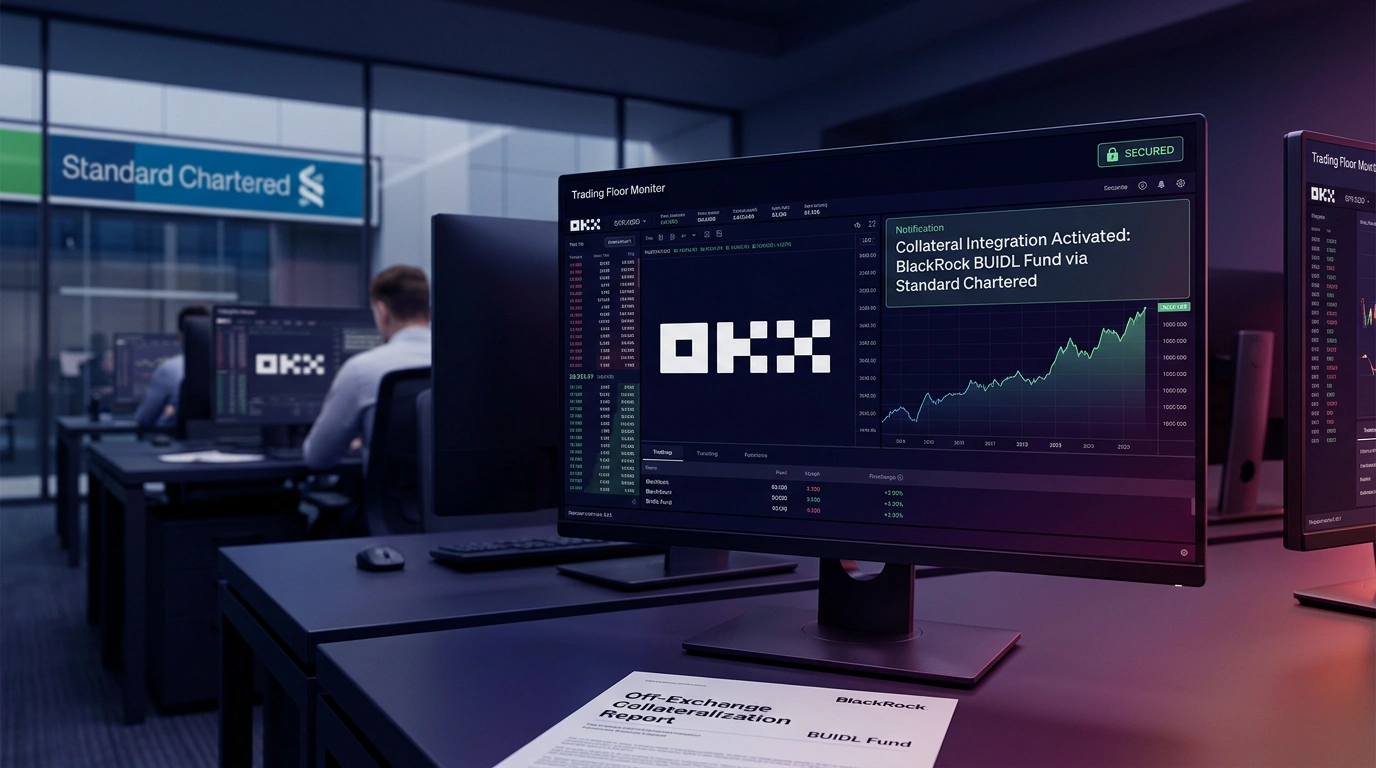
Crypto exchange OKX has integrated BlackRock's BUIDL tokenized US Treasury fund into a collateral program with Standard Chartered. Institutional and VIP clients can now use the fund as trading margin while keeping assets in regulated bank custody and continuing to earn yield. This is the first off-exchange tokenized collateral framework backed by a globally systemically important bank, a G-SIB.
Who is involved and what is BUIDL?
Three parties are central to this deal. OKX acts as the trading venue, BlackRock as the fund manager, and Standard Chartered as the independent custodian. BlackRock is the world's largest asset manager with over $11 trillion under management. Standard Chartered holds G-SIB status under Basel Committee criteria.
BUIDL stands for BlackRock USD Institutional Digital Liquidity Fund, tokenized through the Securitize platform. The fund puts money into short-term US Treasury bills, cash, and repos. Yield is distributed automatically on-chain to fund holders, no manual steps required on the client side.
Standard Chartered holds client assets in accounts legally and operationally separated from OKX's own funds. OKX handles real-time margin requirements and liquidation procedures through its own risk management systems. The program launched for institutional and VIP clients through OKX Middle East, with a phased rollout to other regions planned based on demand and local regulations.
How does the mechanics actually work?
Here is how the whole process flows, step by step.
- Purchase and transfer: the client buys BUIDL shares and transfers them to Standard Chartered as collateral.
- The bank confirms the collateral and reports the available margin limit to OKX in real time.
- The client opens positions on OKX normally, while BUIDL keeps earning yield in their portfolio.
- Within OKX's margin system, BUIDL shares are treated as equivalent to USD and USDC, so positions can be covered without any conversion.
- The client retains full ownership of the asset and all accrued interest throughout the entire collateral period.
Rifad Mahasneh, CEO of OKX Middle East, said the goal of this setup is to put tokenized assets to active use in trading systems rather than holding them passively. He called OKX "the only global digital asset exchange" with this type of framework on the market. On margin calls, OKX processes liquidations through its internal risk management systems.
Why did margin capital not earn returns before?
For most traders, the question may seem purely technical. For large institutions, it is a real operational problem with a clear financial cost. Funds posted as collateral stop working. Lost yield, every single day.
The traditional setup on crypto exchanges worked like this: a client deposits cash or stablecoins, and those assets earn nothing until the position closes. In traditional finance, brokers regularly place client balances in short-term money market instruments. In crypto, that practice never took hold.
At scale, the cost adds up fast. Several hundred million dollars in collateral at current US Treasury bill rates would generate four to five percent annually. On a $500 million portfolio, that comes to $20-25 million per year sitting uncaptured.
Tokenization solves this. A BUIDL share is a digital ownership stake in a fund holding real government bonds and repos. As long as the asset serves as collateral, the underlying instruments generate income that goes directly to the owner on-chain, automatically.
Competitors are moving the same way
Binance has already connected both BlackRock's BUIDL and Franklin Templeton's BENJI to its own off-exchange collateral programs. Competition in the tokenized money market collateral segment is picking up across major exchanges.
The broader market picture confirms the direction. BlackRock reported at the end of 2024 that BUIDL assets under management crossed $1 billion. Analysts tracking the real-world asset market put total tokenized money market fund volume above $5 billion in Q1 2026, with growth continuing.
The race runs on several tracks at once. Asset managers tokenize funds. Banks step in as custodians inside blockchain-based schemes. Crypto exchanges embed these instruments into their margin systems. Each player is trying to lock in a position in the chain connecting traditional finance with crypto markets.
What comes next for the market?
The OKX-BlackRock-Standard Chartered deal confirms that tokenized real-world assets are crossing from pilot projects into actual trading infrastructure. The combination of regulated custody, a major asset manager, and a G-SIB bank clears most compliance hurdles that have kept large institutional funds on the sidelines of the crypto market.
OKX's next step is expanding the program to new regions. If the framework holds up in live conditions, it could become an industry standard for collateral management at major exchanges. First for tokenized Treasury assets, then potentially for a broader range of bonds and funds. The line between TradFi and crypto infrastructure is getting harder to draw.


Comments
Your email address will not be published. Required fields are marked *