


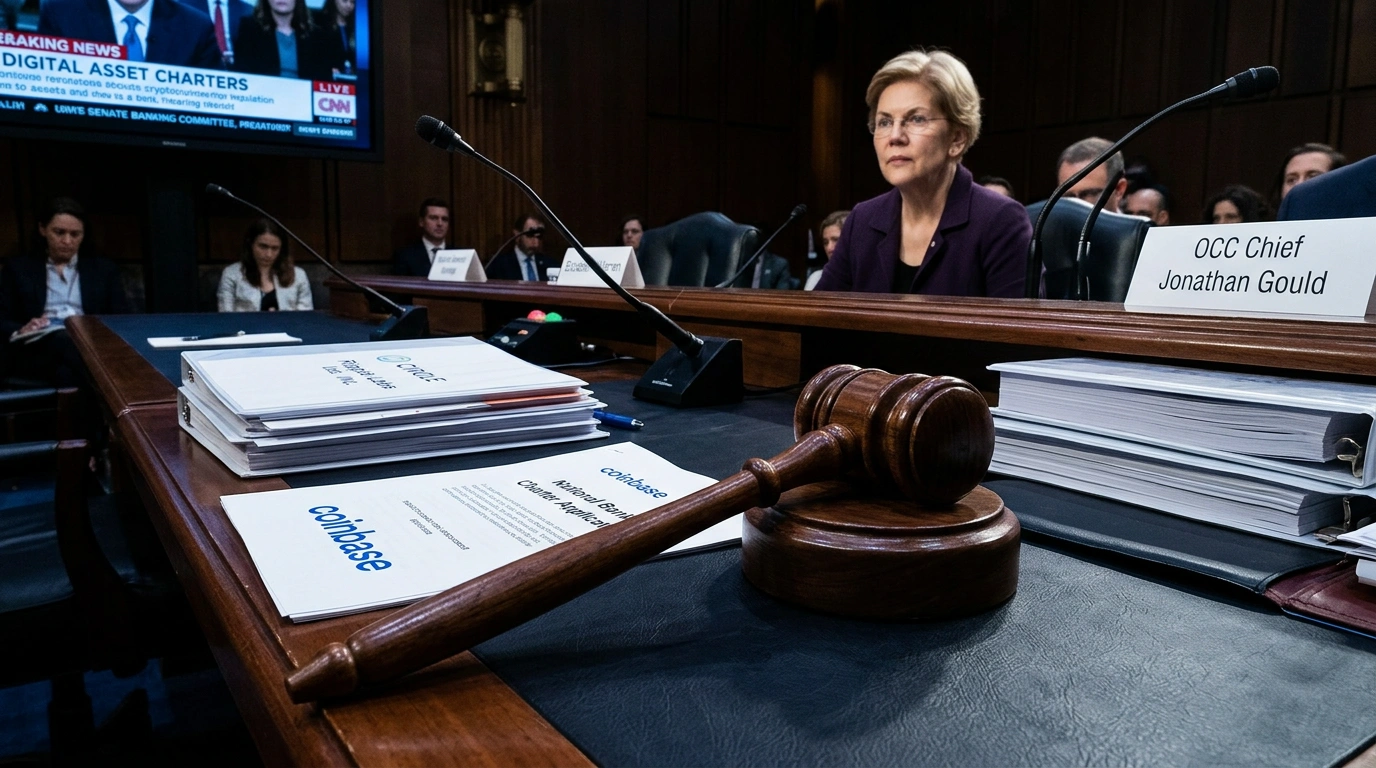
Senator Elizabeth Warren has accused Office of the Comptroller of the Currency (OCC) chief Jonathan Gould of breaking federal banking law. In a letter published Monday, she argues the regulator illegally approved at least nine national trust bank charters for crypto companies starting in December 2025. Among them: Coinbase, Ripple, Circle, and Trump family-linked World Liberty Financial.
Nine Charters in Five Months
Warren is the ranking member of the Senate Banking Committee. In her letter to Gould, she says the OCC "approved at least nine national trust bank charters for crypto companies that intend to engage in activities that appear to go far beyond the narrow set of activities permitted by law." She argues this is a direct violation of the National Bank Act.
The letter is addressed personally to Gould, a Trump appointee. Warren demands the OCC hand over full applications for all companies that received or conditionally received charters from December 2025 to the present. She also requests internal OCC communications related to the charter approval process. The agency did not comment before publication.
Warren says issuing nine charters in under five months is a sharp departure from the OCC's prior practice. Before the current administration, the regulator approached such decisions with considerably more caution. She calls the acceleration deliberate and directly questions the agency's motives.
Who Got Approved
According to the letter, the OCC approved or conditionally approved charters for several major crypto industry participants:
- Coinbase, the largest US crypto exchange
- Ripple, the company behind XRP
- Circle, the issuer of stablecoin USDC
- Stripe, BitGo, and the parent company of Crypto.com
Warren argues that a trust charter lets these companies access banking infrastructure while avoiding the full regulatory burden required of a regular bank. She called this "regulatory arbitrage that poses serious risks to consumers and the safety and soundness of the banking system."
The letter also mentions Payward, the parent company of Kraken, which filed for a trust charter on May 8. If approved, Payward could "provide fiduciary custody and other services primarily for digital assets" under the Payward National Trust name.
The Trump Connection
One key section of the letter raises a potential conflict of interest. Warren asks Gould to provide all communications between the OCC and the Trump administration that may relate to the charter approvals. It is not the first time she has questioned whether the regulator's decisions are tied to the current president's crypto business interests.
Warren pays particular attention to World Liberty Financial. The firm is publicly linked to the Trump family, filed for a trust charter in January 2026, and is pushing a stablecoin called USD1. She called on Gould to pause the review of this application.
"Your decision to facilitate this regulatory arbitrage not only conflicts with federal law, it also poses serious risks to consumers, the safety and soundness of the banking system, and the separation of banking and commerce."
- Elizabeth Warren, ranking member of the Senate Banking Committee, from a letter to OCC dated May 18, 2026
That same week, Warren pushed back against certain provisions of the CLARITY Act during a Senate committee markup. She believes some clauses could shield companies like World Liberty Financial from stronger oversight.
What the OCC Shift Means
A national trust bank charter allows a company to operate as a financial institution at the federal level. The permitted activities are far narrower than those of a full commercial bank. Because of that gap, and the absence of matching obligations, Warren says trust charters are the wrong tool for crypto companies.
The OCC's pace of charter approvals picked up sharply after the change of administration. The applicant pool now includes not just exchanges, but stablecoin issuers, custody services, and payment companies. Each new approval expands what large market players can do under federal oversight.
The CLARITY Act, which would set out the broader structure of the US crypto market, passed a Senate committee markup last week and is moving toward a vote. If the law arrives alongside this wave of new bank charters, the operating rules for crypto companies in the US could look very different.



Comments
Your email address will not be published. Required fields are marked *